You've rested it. You've iced it. Maybe you've had it massaged, needled or strapped. For a week or two your knee feels better. Then you take the stairs at work, or do your Saturday run along the Berg River, and the ache is back.
If that sounds familiar, you're not unlucky, and your knee isn't “just getting old”. In many of the people we see at our biokinetics practice in Paarl, the knee is where the pain shows up. It isn't where the problem starts.
In this post you'll learn why knee pain keeps coming back, which muscles are usually behind it, and what actually fixes it for good.
Why your knee pain keeps coming back
Your knee is a hinge between two bigger players: your hip above and your foot below. It mostly goes where they send it. When the muscles around your hip don't control your thigh well, the knee drifts inward every time you climb a step, squat or land on one leg. Do that a few thousand times a day and the front of the knee starts to complain.
This isn't a theory we made up. Studies on people with pain at the front of the knee (often called patellofemoral pain or runner's knee) keep finding weaker hip muscles and a slower-firing gluteus medius. A 2023 review of 14 studies found that strengthening the hip muscles improved knee pain and function, and in most trials it beat quadriceps exercises on their own.
So if every treatment so far has focused on the knee itself, it makes sense that the relief didn't last. The knee was being treated. The reason it hurt was left alone.
The muscles that stop pulling their weight
Here's the part most people have never heard of. A muscle can be perfectly healthy and still not switch on properly. Your nervous system turns it down.
This happens for a few reasons:
- After an injury, swelling or surgery. The knee sends warning signals to your spinal cord, and the body responds by dialling down the quadriceps. Researchers call this arthrogenic muscle inhibition. It can last long after the original injury has healed, and it often doesn't respond to ordinary strengthening.
- When the opposite muscle is overworking. Muscles work in pairs. If one side stays tight and busy, the muscle on the other side gets told to back off. In practice we often see this with tight hip flexors and sleepy glutes.
- From years of habit. Long hours sitting at a desk or in the car, or always standing on the same leg, teach some muscles to do less and others to do more.
When one muscle goes quiet, its neighbours pick up the slack. They tire, they tighten, and the joint takes load it wasn't built for. That's when your knee starts to ache.
Why stretching, massage and rest only help for a few days
Stretching a tight thigh, massaging a sore hip or resting a painful knee can all feel good. We're not against any of them. The trouble is what they leave out.
The tight muscle is usually tight for a reason: it's covering for one that has gone quiet. Release it, and you get a few days of relief. But the quiet muscle is still quiet, so the tight one gets pulled straight back into overtime. The pain comes back, often in the same spot.
That's why you can feel great walking out of a session on Tuesday and sore again by the weekend. Lasting relief comes from switching the quiet muscle back on, so the overworked one is allowed to let go.
How we treat knee pain at our Paarl biokinetics practice
A biokineticist is a clinical exercise specialist registered with the Health Professions Council of South Africa (HPCSA). We use movement and targeted exercise to treat injuries and pain, especially in the stage where you need to get strong and moving again.
At Esti Smit Biokinetics we use an approach we call The ReWire Method. It works in three steps:
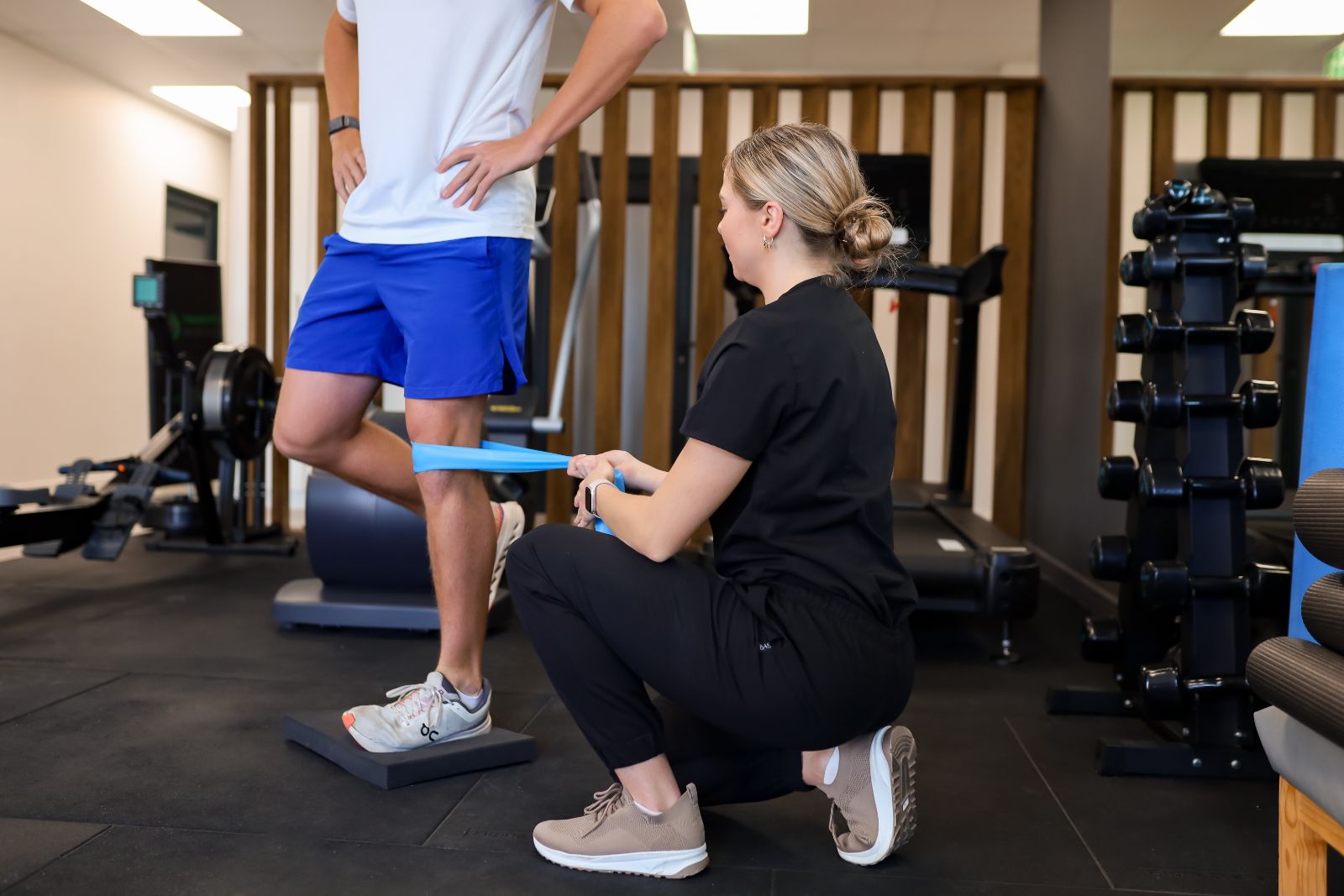
- 1Find the quiet muscles.We test each muscle with light pressure to see whether it fires, not how strong it is. Every test is done lying down, so your body can't cheat by borrowing from other muscles.
- 2Switch them back on.We use specific activation exercises to reverse the inhibition.
- 3Make it stick.Once the muscle fires again, we build its strength and teach it to work in the movements you do every day: stairs, squats, running, gardening, picking up a toddler.
Our goal is mobility, not flexibility. We want your knee and hip to move through a full range while staying stable and strong. A loose joint without control is just a different problem.
Signs your knee pain could be a muscle problem
You may benefit from seeing a biokineticist if:
- The pain is at the front of your knee or around the kneecap
- Stairs, squatting, kneeling or getting up from a chair make it worse
- It flares up after running, hiking or a long drive
- Your knee caves inward when you do a single-leg squat in front of a mirror
- You had a knee injury or surgery months ago and the leg still doesn't feel right
- Massage or stretching helps, but only for a few days
Some knee pain does need a doctor first. If your knee is very swollen, locks, gives way, or you can't put weight on it after a fall or twist, get it checked by your GP or an orthopaedic surgeon before starting rehab.
Frequently asked questions
Sources
- Outcome of hip exercise in patellofemoral pain, systematic review (Thomson et al., 2016)
- Hip abductor and lateral rotator strengthening in patellofemoral pain, meta-analysis (Alammari et al., 2023)
- Quadriceps arthrogenic muscle inhibition: neural mechanisms and treatment (Rice & McNair, 2010)
- Biokinetics: a South African health profession (Ellapen et al., 2018)